Campaign Video That Converts

Hamra
We film and composite all our videos right here at our studio to maintain our top quality standards and accuracy.
Video builds trust and leads when you pick the channel, format, and spend mix on purpose—not when you drop one cut everywhere and hope.
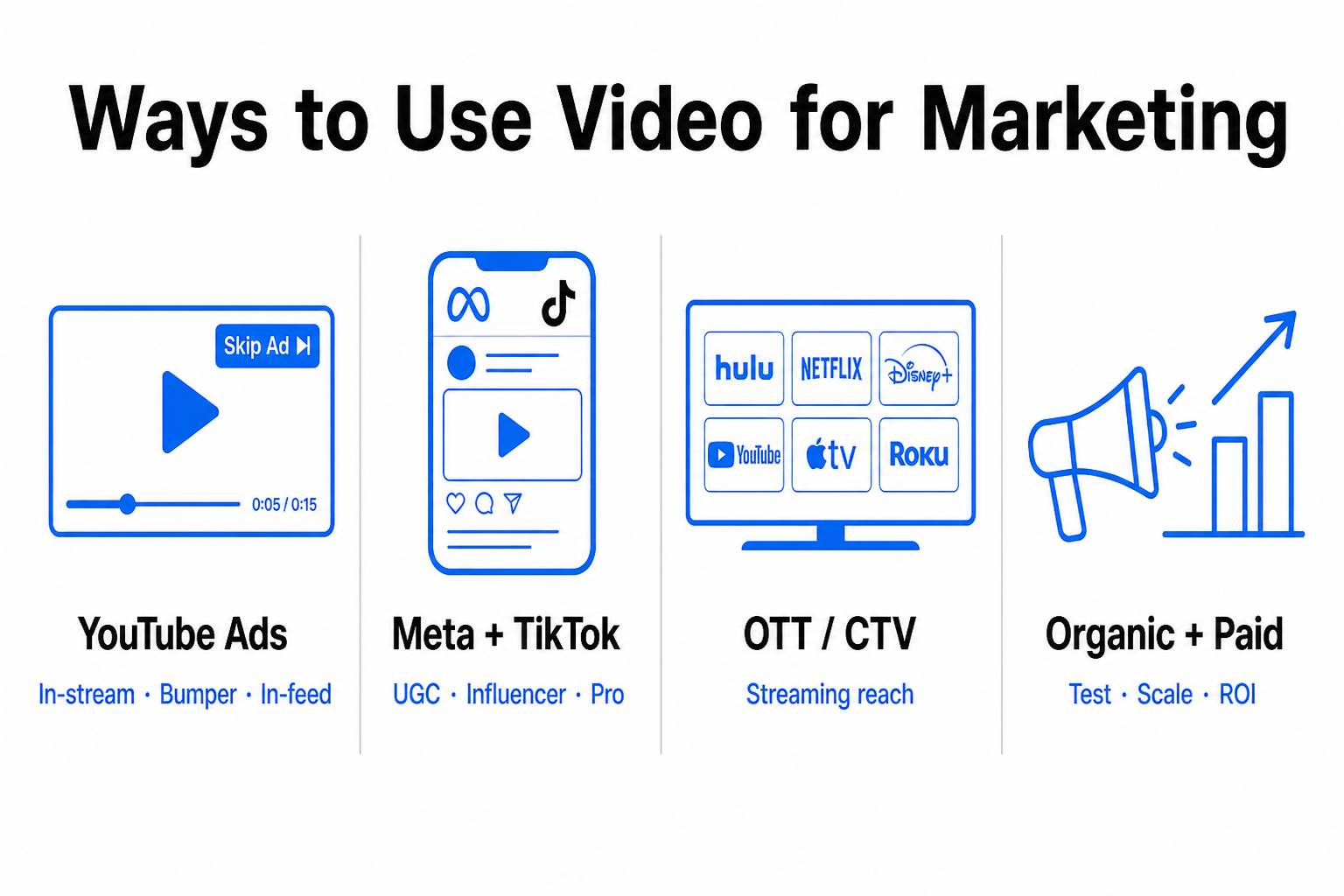
Talking Heads’ Video Marketing page walks the growth process, organic vs paid, YouTube placements, Meta/TikTok formats, and OTT/CTV. Use it as the campaign map.
This article expands those ways to use video for marketing—and how a website spokesperson fits the post-click and trust layer of the stack.
We film and composite all our videos right here at our studio to maintain our top quality standards and accuracy.
Before you debate aspect ratios, lock the process: pinpoint who must see the message, launch where they already pay attention, test real performance, then scale what works. That four-step loop is the backbone of Talking Heads video marketing.
Everything below is a channel menu on top of that loop—organic vs paid, YouTube units, social formats, and streaming TV—plus where website video closes the click.
Open the source playbook for the growth process, ad placements, and social formats:
Video Marketing That Builds Trust and Leads (Talking Heads)
Skip “make a video and post it.” Run marketing video like a campaign:
Who needs the message, and where do they already engage—YouTube, Meta, TikTok, search landers, or streaming TV?
Launch where notice and response are likely. One primary CTA. One offer. Measure from day one.
Read view-through, CTR, and post-click conversions. Kill weak hooks. Extend winners into longer lander cuts.
Raise spend, repurpose cuts across placements, and feed long-term growth—not a one-shot upload.
Use both with different jobs:
If you are not investing in smart paid yet, treat a small test budget as research: put the right ad in front of the right people, then keep the creative that proves itself in organic and on-site.
YouTube is still the workhorse for intent and scale. Strategize which placement captures attention for your offer:
Pre-, mid-, or post-roll. Skippable for longer offers; non-skippable when you need guaranteed seconds. Front-load the hook and brand.
Six-second hits for frequency and recall. Pair with longer units that explain the offer.
Discovery-style units that compete like organic thumbnails. Thumbnail + title do half the work.
Video outside YouTube inventory—expand reach when the message travels beyond the watch page.
Cut lengths and CTAs per unit. A bumper and a 30-second skippable in-stream should share a message, not the same edit.
Facebook, Instagram, and TikTok prioritize short, engaging video. Use motion, clear messaging, and platform-native pacing to grab attention, build trust, and move viewers to a lander—not to dump a website VSL into the feed.
Three production lanes cover most social campaigns:
DIY feel, high relatability. Strong for trust, hooks, and comments. Great cold-traffic openers.
Creators with an audience that already matches your market. Borrow reach and credibility.
Actors, scenarios, animation, and graphics that explain the product and inspire the buy. Use for brand polish and retargeting.
Mix formats across the funnel: UGC for scroll-stop, polished talking-head or demo for consideration, spokesperson or VSL on the post-click page.
When you need living-room attention:
OTT/CTV ads are targeted, trackable, and high-engagement versus unmeasured linear spots. Plan aspect ratio, sound-on viewing, and shorter brand-first opens for the big screen.
Talent note: Licensing for OTT, CTV, and CATV can differ from standard website and internet video. Confirm usage before you shoot for TV-scale distribution—talk it through with your rep when you plan video marketing.
Ads create demand. The website converts it. After the click:
Green screen talent keeps backgrounds flexible when campaign creatives change faster than you can rebook actors—see green screen video.
Solution: Export per placement—bumper, skippable, vertical social, lander, CTV. Same message, different length and framing.
Solution: Send traffic to a page with matching video and a single CTA. Do not dump ad viewers on a generic homepage.
Solution: Prove hook and offer on a small budget, then scale. Raise spend on winners only.
Start with a clear audience and one message, then use a small paid test to learn fast while you build organic assets you can keep using. Organic compounds; paid accelerates reach and proof.
Most brands start with skippable in-stream for mid-length offers, bumper ads for frequency and brand recall, and in-feed for discovery. Match length and CTA to the placement—not one cut for every unit.
UGC-style builds trust fast, influencer-style borrows an existing audience, and higher-production video sells polish and clarity. Many campaigns mix formats: UGC for hooks, polished cuts for landing pages and retargeting.
Often yes. Talent licensing for OTT, CTV, and CATV can differ from standard website and internet video. Confirm usage rights before you shoot for streaming TV.
Channel plan first—then production and placement: